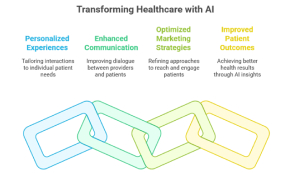

Artificial intelligence is rapidly transforming the healthcare landscape—and that includes how organizations connect with patients. For hospitals, clinics, pharmaceutical companies, and startups, AI-powered marketing tools are not just a trend; they’re redefining how healthcare engagement works. These tools help improve patient communication, automate data analysis, predict behavior, and optimize campaigns—all while staying aligned with strict regulations.
In today’s healthcare marketing world, AI is helping segment audiences, personalize outreach, and improve the customer experience. Tools like chatbots and virtual assistants aren’t just making processes more efficient; they’re creating better, more meaningful interactions. Whether managing CRM systems or refining content strategies, AI enables healthcare marketers to reach the right people at the right time.
Let’s dive deeper into the essential tools, applications, and future potential of AI in healthcare marketing.
1. Which AI Tools Are Used in Healthcare?
Here are some of the most impactful AI tools in healthcare:
⦁ IBM Watson Health: Analyzes vast amounts of medical data to support diagnostics and treatment planning.
⦁ Google DeepMind: Powers disease prediction and imaging analysis.
⦁ DAX Copilot (by Microsoft): Transcribes doctor-patient conversations in real-time, reducing paperwork for doctors.
⦁ PathAI: Enhances diagnostic accuracy in pathology.
⦁ Butterfly Network AI: Interprets ultrasound scans through portable devices.
⦁ Infermedica: Assists in symptom checking and triage.
On the marketing side, tools like ChatGPT, HubSpot (with AI integrations), and Salesforce Health Cloud are streamlining communications, automating lead generation, and crafting personalized patient journeys.
2. What is DAX Copilot?
DAX Copilot, created by Microsoft and Nuance, listens to doctor-patient conversations and automatically generates clinical documentation in real time. This reduces the need for manual note-taking, freeing physicians to focus on what matters most: patient care. It’s already making waves in hospitals and clinics, helping reduce clinician burnout and improve efficiency.
3. Which AI Tools Power Healthcare and Marketing?

In the bigger picture, these AI tools are game-changers:
⦁ Machine Learning: TensorFlow, PyTorch
⦁ Natural Language Processing: GPT (OpenAI), BERT
⦁ AI Marketing Tools: Jasper AI, Grammarly AI, MarketMuse
⦁ Healthcare Platforms: Olive AI, Aidoc, Viz.ai
For marketing, AI-powered chatbots, email automation, and social listening tools like Brandwatch AI refine how healthcare brands target and engage audiences.
4. How is AI Currently Used in Healthcare?
AI is already a driving force in:
⦁ Diagnostics: Analyzing medical images for faster, more accurate results.
⦁ Patient Monitoring: Wearables and IoT devices linked with AI for continuous tracking.
⦁ Drug Discovery: Speeding up R&D with predictive modeling.
⦁ Virtual Assistants: Chatbots offering 24/7 health support.
⦁ Marketing: Delivering personalized messages and anticipating patient needs.
These innovations are boosting both clinical outcomes and marketing effectiveness.
5. What is the Future of AI in Healthcare?

Looking ahead, AI’s potential includes:
⦁ Predicting diseases before symptoms show
⦁ Real-time, tailored treatment recommendations
⦁ Virtual hospitals with AI at the helm
⦁ Generative AI creating educational and marketing content
⦁ Automated billing and insurance workflows
Healthcare marketing will become increasingly AI-driven, offering deeper insights into patient behavior and delivering more personalized digital experiences.
6. How is AI Shaping Healthcare in India?

In India, AI is driving innovation through:
⦁ Telemedicine platforms like Practo and mfine for online consultations.
⦁ Startups like Qure.ai, which use AI to detect tuberculosis and analyze radiology images.
⦁ Ayushman Bharat Digital Mission, leveraging AI for electronic health records.
Indian hospitals and healthcare startups are also tapping into AI for multilingual chatbot support, targeted social media campaigns, and robust health analytics.
7. What AI Domains Power Healthcare?
Healthcare relies on several AI domains:
⦁ Machine Learning: Drives predictive analytics and diagnostic tools.
⦁ Natural Language Processing (NLP): Understands medical texts and conversation data.
⦁ Computer Vision: Interprets medical images like MRIs and X-rays.
⦁ Robotic Process Automation (RPA): Handles tasks like claim processing and admin work.
These same technologies fuel healthcare marketing by making data analysis, personalization, and content automation smarter and faster.
8. Why Isn’t AI More Widespread in Healthcare?
Despite its advantages, AI adoption faces hurdles:
⦁ Concerns over data privacy
⦁ High implementation costs
⦁ Limited AI literacy among healthcare professionals
⦁ Regulatory and compliance challenges
⦁ Difficulty integrating with existing systems
In marketing, there’s often hesitation due to fears of losing the human touch or misaligning with healthcare advertising regulations.
9. What’s Microsoft’s Role in AI for Doctors?
Microsoft is making strides in AI healthcare solutions:
⦁ Nuance DAX Copilot: Automates clinical documentation.
⦁ Microsoft Cloud for Healthcare: Offers integrated tools for patient engagement, data analytics, and care coordination.
⦁ Azure AI for Health: Provides machine learning models and APIs tailored for healthcare.
These tools help doctors streamline workflows and provide marketers with rich insights into patient behaviors and needs.
10. Examples of AI Medical Devices
Two standout innovations:
⦁ IDx-DR: The first FDA-cleared AI diagnostic tool to detect diabetic retinopathy independently.
⦁ Butterfly iQ: A portable ultrasound device that uses AI to guide even non-specialists through imaging.
These devices highlight how AI is bridging the gap between diagnostics and marketing, requiring innovative, AI-driven marketing strategies to stand out in competitive markets.
Ready to Transform Your Healthcare Marketing?
AI is already reshaping how healthcare providers connect with patients—and the best time to embrace it is now. Whether you’re a clinic looking to streamline outreach, a hospital aiming to personalize engagement, or a healthcare startup seeking a competitive edge, AI tools can help you get there.
Let’s talk about how AI can power your healthcare marketing success. Contact us today to explore your options and take the first step toward a smarter, more connected future.